
Posted on November 2, 2026 by Anastasia Cisneros-Lunsford
Two Computer Science faculty members received a teaching fellowship to help students question AI-generated answers and strengthen their critical thinking and problem-solving skills.
UT San Antonio students in the College of AI, Cyber and Computing may be using artificial intelligence to solve mathematical problems almost instantly, but learning to evaluate the reasoning behind those answers and identify potential errors is an important part of the process.
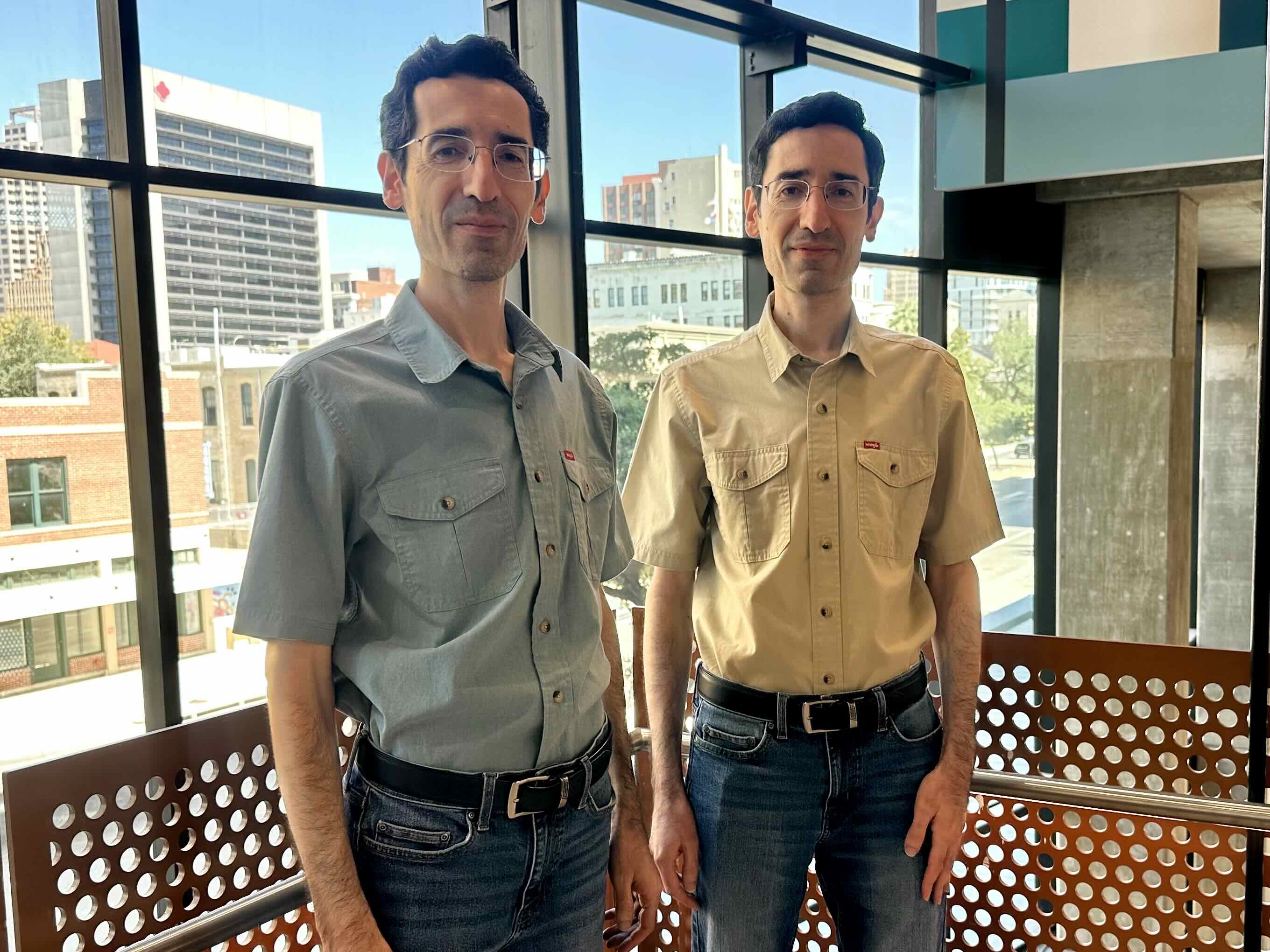 To teach students to analyze and verify AI‑generated solutions, computer science associate professors Amin Sahba, PhD, and Ramin Sahba, PhD, have received the Kay and Steve Robbins Faculty Teaching Fellowship to redesign portions of the CS 3333 Mathematical Foundations of Computer Science course around the guided use of large language models (LLMs), a type of AI trained to understand and respond to language. Although an LLM can generate answers to many problems, those answers may be incorrect or rely on incomplete reasoning.
“Our project is about teaching students how to learn with AI instead of simply getting answers from AI,” Ramin said, adding that by using LLMs as learning tools, students may go beyond the correct answer. “Students may be asked to examine the AI's reasoning, compare different solutions, identify errors, improve the response or explain why a particular solution is correct.”
The center of the Sahbas’ project is to use AI to strengthen students’ thinking, not to replace it.
Rethinking AI in the Classroom
Students are increasingly using tools such as ChatGPT to complete math and computer science coursework. The goal is not to stop them from using AI but to reshape how students use these tools, the professors said.
CS 3333 is particularly suited for the fellowship project because it goes beyond memorizing facts and emphasizes learning how to reason. The course covers probability, statistical models, number theory and combinatorics, the study of counting and arranging possibilities. These areas require students to work through multistep problems and understand why a solution works.
“We want to teach them how to use it in a way that supports learning,” Amin said. “We want students to question AI-generated answers, understand the reasoning behind them, find mistakes and develop their own solutions.”
The Sahbas will redesign assignments around guided AI use and make evaluating an AI’s work just as important as solving the original problem. Students won’t simply show an answer; they’ll learn to interrogate it, validate it and ultimately think more critically than the tool itself.
“Getting an answer from an AI tool can be easy,” Ramin said. “Determining whether that answer is correct is much harder.”
Building AI Literacy
Learning to distinguish why a solution is right or wrong matters beyond a single mathematics course, the professors said. Students taking the course will be better prepared for later courses in algorithms, machine learning and deep learning and will gain the following:
- Stronger mathematical reasoning
- Better problem-solving skills
- AI literacy
- Experience recognizing errors and limitations
- Confidence in making their own informed decisions
The goal, Ramin said, is for students to develop AI literacy, which is something increasingly important for their future careers.
“(Students) should know how to use AI effectively but also when not to trust it,” Ramin said. “We want them to be able to ask good questions, evaluate AI-generated information, recognize errors, compare possible solutions and make their own informed decisions.”
The Sahbas will evaluate student learning through pre- and post-assessments, problem-solving activities, course performance and student feedback. They also plan to create a reusable teaching toolkit with assignments, prompt strategies, assessment materials and teaching guidelines that other instructors can adapt.
Amin said the fellowship allows him and his identical twin brother to explore a teaching challenge that is becoming increasingly important.
“AI is changing very quickly, and educators need to think carefully about how we prepare students to use these technologies responsibly and effectively.”
— Anastasia Cisneros-Lunsford
