
Posted on November 17, 2026 by Anastasia Cisneros-Lunsford
Working with real local data, students develop practical tools to help the community assess flood risks and make safer decisions during severe weather.
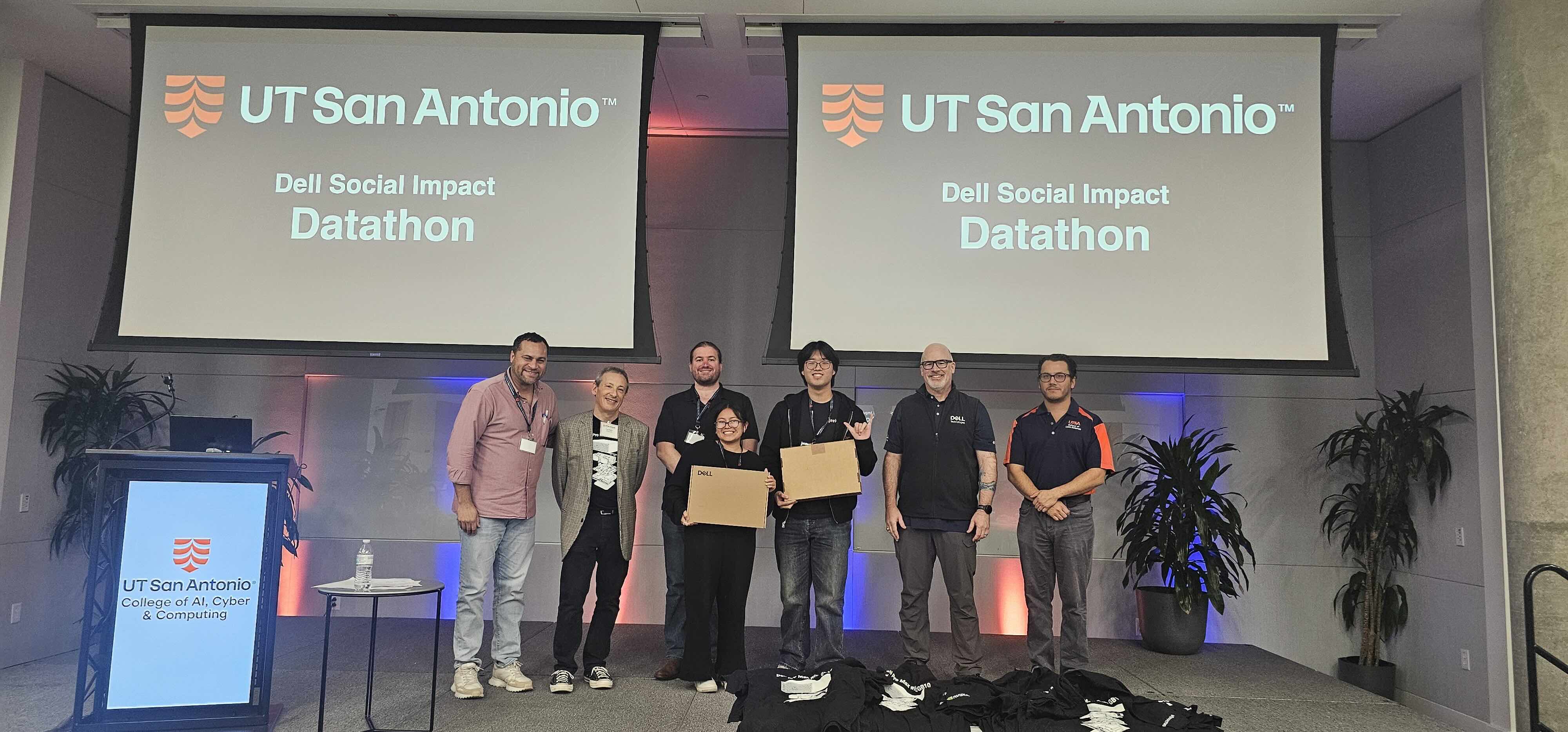 For one day, UT San Antonio students in the College of AI, Cyber and Computing traded lectures and textbooks for artificial intelligence models, real-world datasets and a race against the clock.
During the Dell Technologies Social Impact AI Datathon, 150 students working in teams used Texas flood data to develop tools that could help residents better understand flood risks, plan evacuations and make safer decisions during severe weather events.
Hosted through a collaboration between Dell Technologies and the College of AI, Cyber and Computing, with support from the Center for Data Science, the Nov. 13 competition at San Pedro I challenged students to analyze flood imagery, weather data and other datasets to build practical solutions for real-world impact.
Organizers said the event was designed to strengthen technical skills and show students how AI can improve quality of life and address community challenges.
 “As we conceived of the event, we became enthusiastic about having students work with data to improve the quality of life for the people of San Antonio,” said Chair of the Department of Computer Science Fred Martin, PhD.
Students explored the social impact of artificial intelligence, centering on datasets, including satellite imagery of floods and non-flood data. Anthony Rios, PhD, associate professor and director of the Center for Data Science, said participants also analyzed rainfall, location and weather data, to develop solutions that could help communities prepare for and respond to flooding.
The competition also gave students access to Dell GB10 AI workstations, powerful computers designed to run advanced AI models and process large amounts of data.
 For Team Yogurt, the datathon challenge inspired a flood-awareness phone application designed to help people visualize how quickly floodwaters can rise during flash-flood events.
“We noticed that a lot of people don’t take flood alerts seriously,” said Fabian Figueroa, a senior computer science major. “People don't really realize how dangerous it is until it’s too late.”
Using historical flood data from Texas, the team’s application allows users to see how rapidly water levels rose during previous disasters.
“You can see just how high the water can get and how quickly it happens,” Figueroa said. “It helps people understand the danger before they're actually in that situation.”
 Teammate Jesus Pantoja, also a computer science senior, said working on the project changed the way he thinks about flooding.
“I used to see a flash-flood warning and think, ‘It’s probably not that dangerous,’” Pantoja said. “But some people need to realize it really is a danger.”
Another team developed FloodSafe, an AI-powered platform that combines historical flood information, interactive maps and a chatbot to help users make safer travel and evacuation decisions during severe weather.
The event gave students an opportunity to apply classroom concepts in a real-world setting.
 “Being here is a completely different environment, and I feel like I’ve learned so much more,” said John Delgado, a sophomore majoring in cybersecurity, information systems and technology, and marketing. “I really appreciate the chance to work on something practical.”
Rios said he hopes experiences like the datathon will leave students with more than just technical skills.
 “Students learned skills in programming and software development, using AI models and working in teams, sometimes with people they have never met before,” he said.
Martin said participants should feel excited about technology and the possibilities it creates.
“(They should) get excited about how they could make the world a better place by working with data and AI and using their own creativity,” he said.
Winners were students from UT San Antonio, except for third place, which featured students from Northwest Vista College. The list included with team and student names:
- 1st Place: Hwaiting, Eric Lee and Josie Sauceda
- 1st Place: Codix, Francisco Espinoza and Paula Com Morales
- 1st Place: Data Dawgs, Ranya Bhartiya and Maneeshkumar Lillyprabhu
- 2nd Place: Flood Runners, Ahaan Vohra, Zachary Melton and Isaiah Romanski
- 2nd Place: High Ground, Kosha Antala, Maanasa Baskar and Shubhangi Kumbhar
- 3rd Place: Cache Cats, David Cortinez, Orlando Garcia, Zachary Barron, Maria Khakimov and Adam Daoud
— Anastasia Cisneros-Lunsford
