Posted on July 29, 2026 by Anastasia Cisneros-Lunsford
College of AI, Cyber and Computing students showcased research addressing real-world challenges in health care, technology and sustainability at the Summer Symposium 2026.
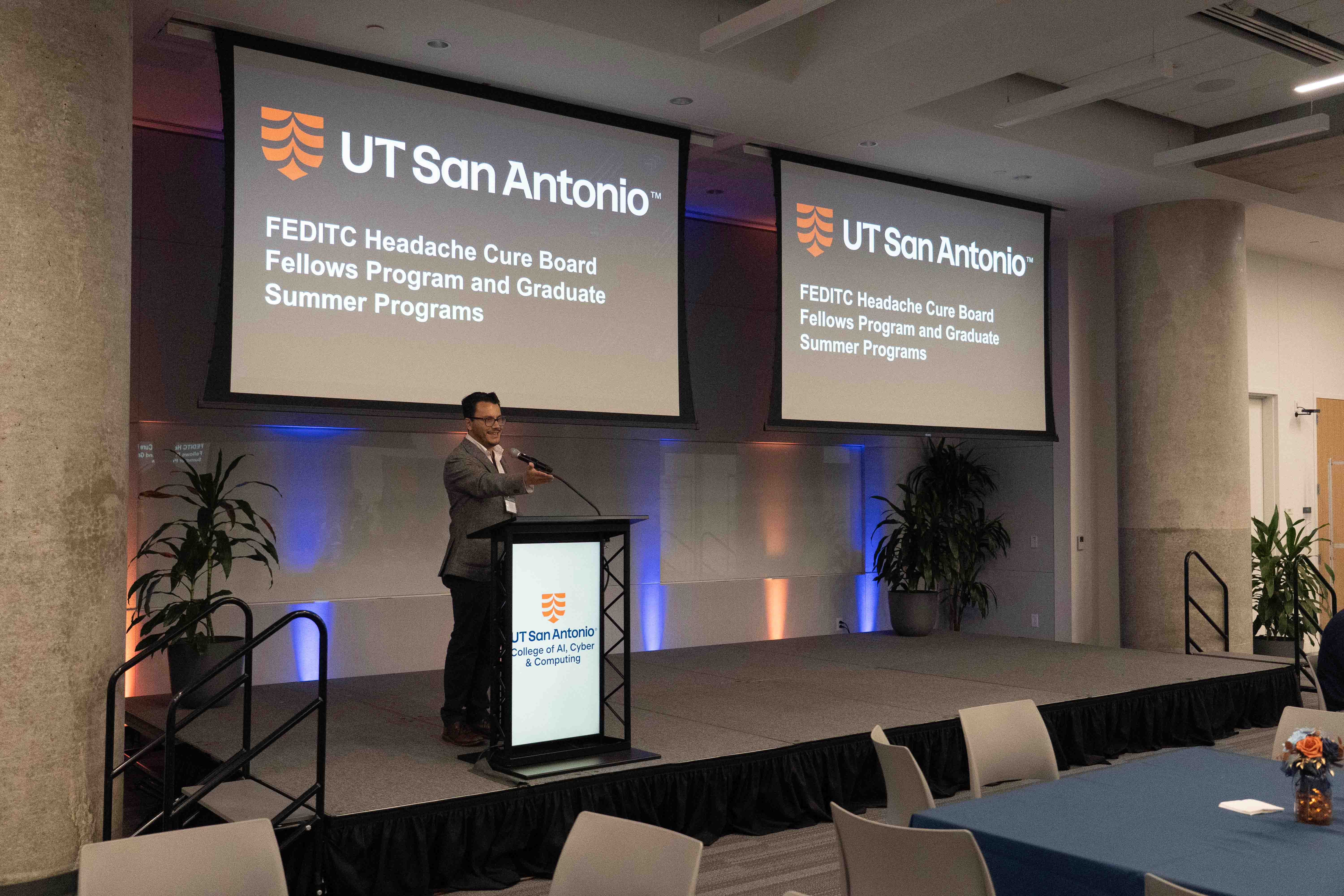 From exploring new benefits for people with dementia to examining renewable energy solutions to power data centers, UT San Antonio student researchers from the College of AI, Cyber and Computing tackled challenges in health care, technology, sustainability and more during the university’s Summer Symposium, held July 29 at San Pedro I.
The day-long event featured projects from the H-E-B Undergraduate Research Fellowship, National Science Foundation Research Experience for Undergraduates, H-E-B Community Innovation Scholars, and the FEDITC Headache Cure Board. Students from multiple disciplines translated their research into practical solutions.
Lizet Casas, Summer Symposium organizer and assistant director of the USAA Student Success Center at the College of AI, Cyber and Computing, said what stood out at this year’s symposium was the remarkable diversity of the faculty-mentored projects.
“From community-engaged research and nonprofit data analytics to artificial intelligence, cybersecurity and advanced computing applications, every presentation reflected our students’ innovation, dedication and commitment to solving meaningful problems,” Casas said.
During the H‑E‑B Undergraduate Research Fellowship presentation session at the symposium, Statistics and Data Science major Zahra Del Rosario shared her team’s research on auricular therapy, a treatment that stimulates specific points on the ear, and pain management as potential non‑drug approaches for improving cognitive function. Using AI and machine‑learning tools, Del Rosario, and graduate researcher Enduo Nan, analyzed data from multiple studies to help medical professionals better understand how these approaches may support dementia care.
“We still need to perform additional research for evidence and open interpretation,” Del Rosario said. “We need to use AI and machine learning to enhance the evidence and receive it faster.”
National Science Foundation-sponsored student researchers Samuel Rivera Diaz, Daniel Wood and William Qian examined the growing impact of AI data centers on the power grid. Diaz researched whether data centers could incorporate more renewable energy sources into their power systems. The answer is yes.
Using on-site generators as backup power sources, data centers are drawing tremendous power from central power grids, Diaz explained.
“(About) 2% of the earth’s power as of right now is being consumed by data centers. In 2024, they made up 5.7% of the electricity consumption of Texas alone,” he said. “And the way AI is going these days, it’s pretty evident that these numbers are only going to get bigger.”
He said renewable energy sources are currently being tested for long-term viability as primary and secondary power sources. His study quickly ruled out hydroelectric dams, wind farms and hydrogen fuel cells as promising alternatives. Diaz’s research explored solar power systems as reliable renewable green sources of power.
“One of the best sources, in my opinion, of green power is solar power. You can use it almost anywhere as long as you have enough sunlight,” Diaz said. “(These systems) burn pretty efficiently in terms of energy.”
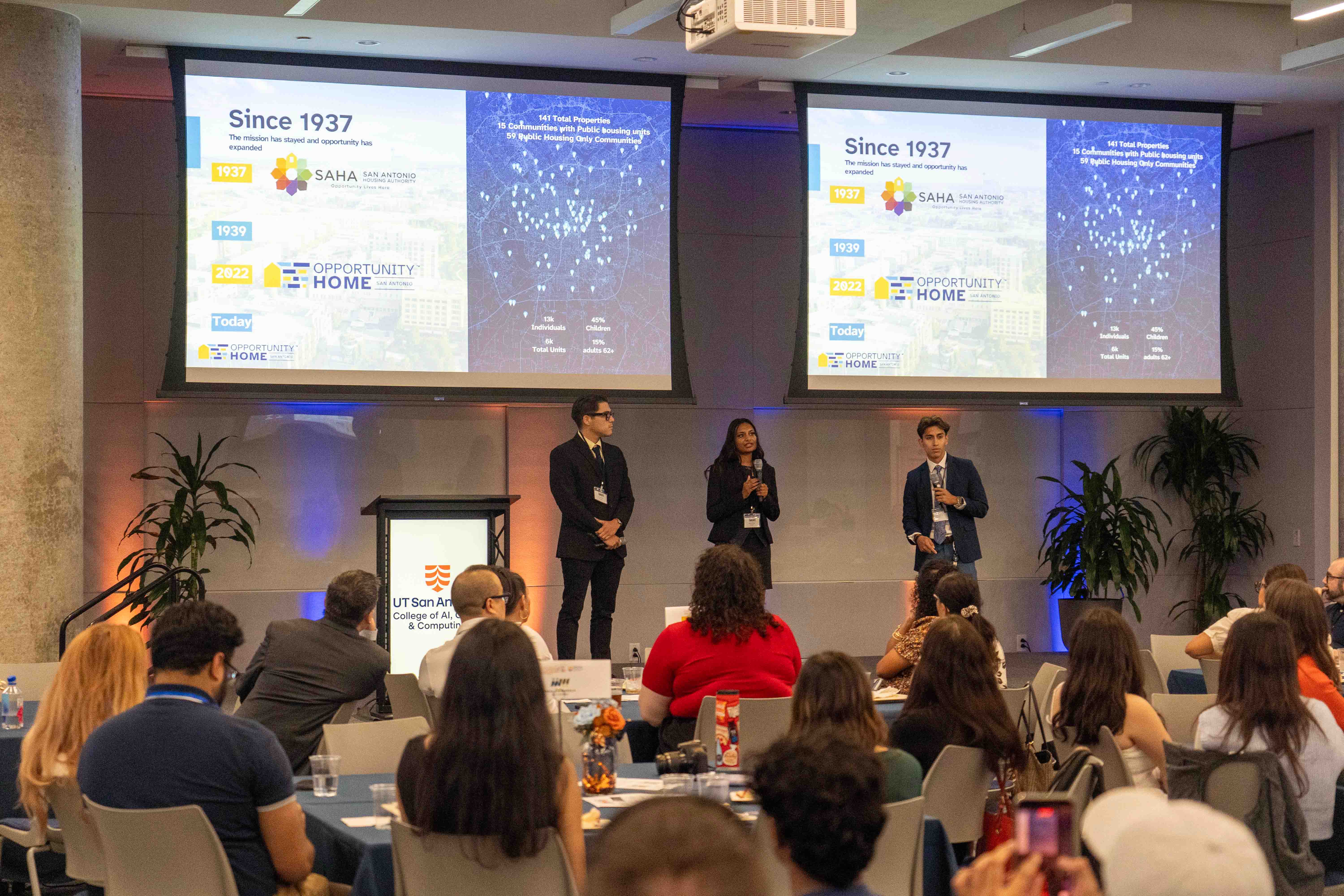 The Summer Symposium showcased more than research findings. It highlighted students’ ability to communicate complex ideas, defend their work and connect with the university and broader community that helped shape many of the projects.
“It was exciting to watch those conversations continue during the poster session as they confidently discussed their research with faculty, industry professionals, nonprofit partners, and guests,” Casas said. “Their enthusiasm reinforced just how impactful these collaborations have become for our students and the organizations they serve.”
Casas worked with faculty mentors, community partners, staff from multiple departments, and students at every level to bring the event to life. Despite the many moving parts, she said the students’ work — and the lasting impact it will have — makes the effort behind an event of this scale more than worthwhile and shows how investing in student research remains a priority for the college.
— Anastasia Cisneros-Lunsford
Picture top right: Anthony Rios, PhD, introduces students to present their research as part of the FEDITC Headache Cure Board.
Picture bottom left: Students present their findings as part of the H-E-B Community Innovation Scholars program during the Summer Symposium.