Posted on July 24, 2026 by Anastasia Cisneros-Lunsford
An NVIDIA Academic Grant is providing advanced AI computing resources to support research and hands-on student learning in the College of AI, Cyber and Computing.
A newly awarded NVIDIA Academic Grant will help UT San Antonio researchers develop artificial intelligence (AI) technologies that are more efficient, private and accessible while expanding hands-on research opportunities for students.
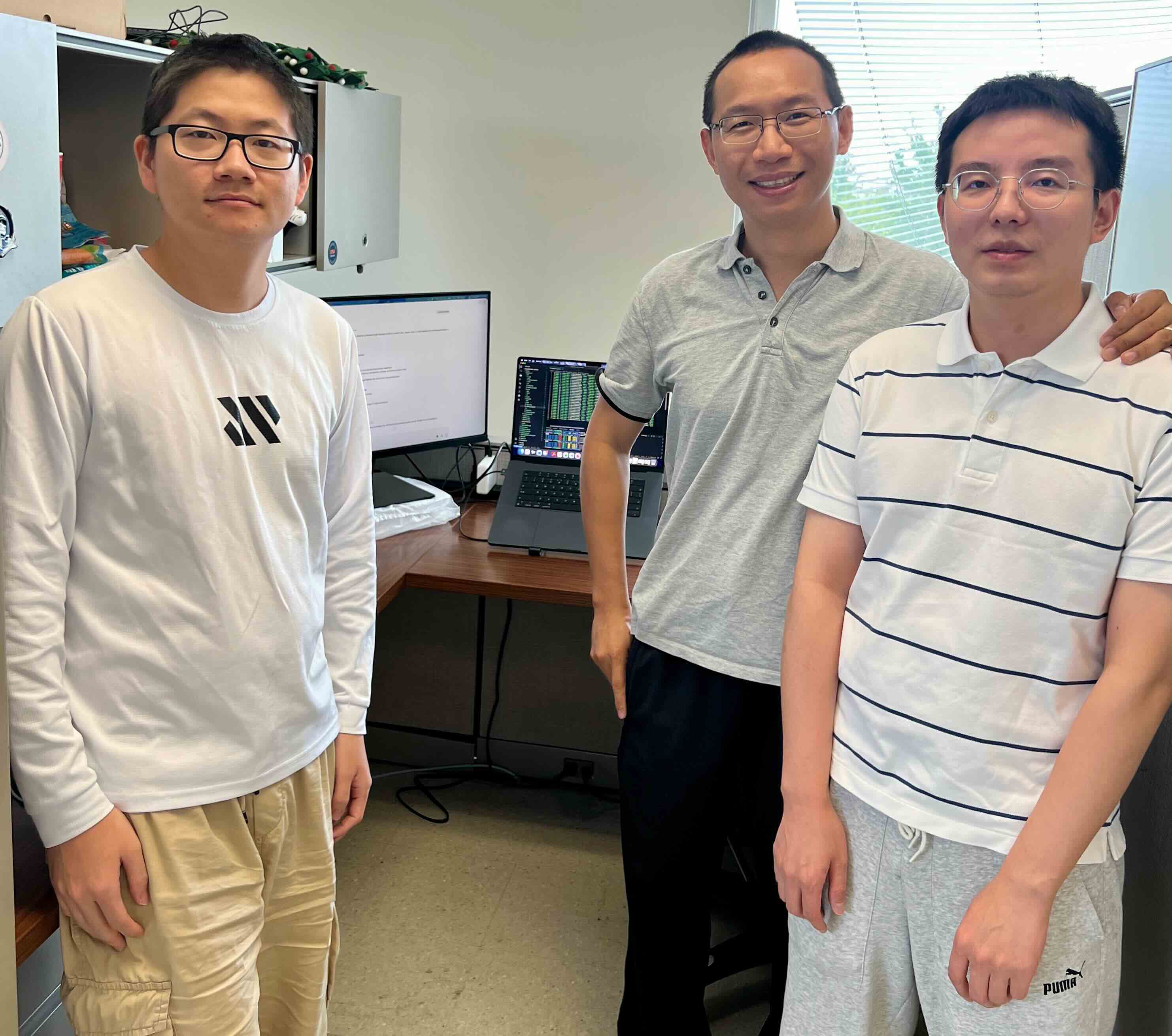 Yuanxiong “Richard” Guo, PhD, an associate professor in the Department of Information Systems and Cybersecurity, received an in-kind industry gift from NVIDIA in the form of advanced AI computing resources.
NVIDIA first gained recognition for its graphics processing units (GPUs), which transformed video gaming with faster, more realistic graphics. Researchers later discovered that those same processors could perform the massive calculations needed for AI and other advanced computing applications. Today, NVIDIA is a global technology company and a leader in AI computing, developing chips and software that power many of today's AI applications.
Guo, whose teaching focuses on artificial intelligence and data science, including courses in deep learning and data mining, said NVIDIA’s support through the Academic Grant Program will help build the computing infrastructure needed to develop practical AI solutions that address real-world challenges and benefit society.
“These GPU resources will directly accelerate our research and student training in AI, federated learning, privacy-preserving computing, and edge intelligence,” Guo said.
The goal of Guo’s research project is to make advanced AI tools available to more people and organizations by reducing the cost and computing resources needed to use them while protecting sensitive information. Powerful AI systems such as ChatGPT, Gemini, and Claude are rapidly changing the way people work and solve problems across many industries.
“The goal of this project is to democratize AI by making powerful large language models more accessible, affordable, and privacy-preserving,” Guo said.
The project supports UT San Antonio’s broader goals of advancing AI, cybersecurity, computing and data science while giving students hands-on experience with the same advanced computing technologies used by leading researchers and technology companies.
Guo said students will work directly with high-performance GPU resources while helping develop, evaluate, and test new AI tools and applications. They will participate in research focused on making AI systems more efficient, privacy-preserving and accessible, gaining practical skills that will prepare them for careers in AI, technology, research and other fast-growing fields.
Looking ahead, Guo said his team hopes to demonstrate that advanced large language models can operate efficiently across a wide range of computing platforms, including powerful research workstations and smaller, everyday devices, without relying exclusively on large and expensive data centers.
The project will run through July 2027 and is expected to produce peer-reviewed publications and open-source software. It will also support continued collaborations with researchers at the UT San Antonio Health Science Center campus to apply large language models to real-world healthcare challenges.
— Anastasia Cisneros-Lunsford
Pictured above: Working with Yuanxiong (Richard) Guo, PhD, center, on AI research made possible by a NVIDIA Academic Grant, are Department of Information Systems and Cybersecurity students Yifan Gao, left, and Jizhong He.