Posted on June 1, 2026 by Anastasia Cisneros-Lunsford
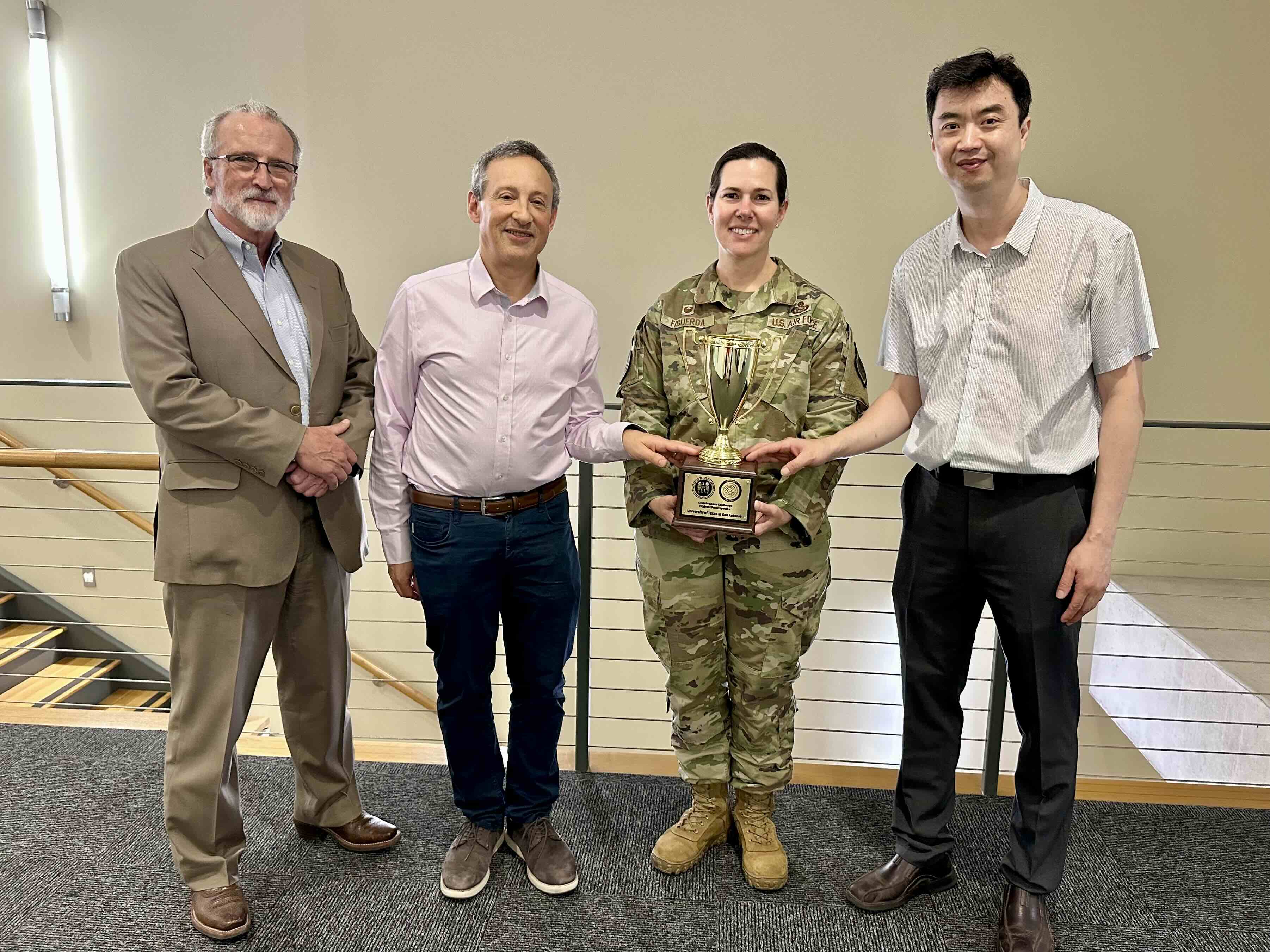 The National Security Agency recognized UT San Antonio for having the most student participants registered for the 2025 NSA Codebreaker Challenge, highlighting the university's commitment to student growth, innovation, and excellence in cybersecurity education.
With 334 student codebreakers from UT San Antonio, the overall competition attracted 533 schools and more than 6,000 students. The NSA Codebreaker Challenge gave students a chance to strengthen their reverse-engineering and cryptography skills through a realistic cybersecurity scenario, while introducing them to the tools, techniques and concepts used by professionals in the field.
Cybersecurity professor of practice Benjamin Anderson said the competition is linked to professional growth, which plays an important role in motivating students to participate.
"As the coach of our cybersecurity competition teams, I am aware of the great career opportunities that can be unlocked by participating in these kinds of events, so I strongly encourage my students to take part," Anderson said, adding that 74 of his students participated in the Codebreakers Challenge, highlighting a wider effort across faculty and departments to get students involved.
Anderson is coach of UT San Antonio cybersecurity competition teams, including Collegiate Cyber Defense Competition (CCDC), Collegiate Penetration Testing Competition (CPTC), CyberForce and the Alamo ACE Capture the Flag. He said the faculty also made a concerted effort to recognize students' participation in competitions and raise their visibility with partner organizations, including the government agencies and contractors that hire many UT San Antonio graduates.
"I am just incredibly impressed with the engagement of our students in this competition," he said. "This past year was our strongest participation ever, so I am incredibly optimistic about what our students will achieve as we go forward."
Professor and Chair of the Department of Information Systems and Cybersecurity (ISC) Charles Liu said the Codebreakers Challenge offers a great experiential learning opportunity for all students.
"Rather than creating a few focused teams or only recruiting students who have been successful in other competitions to participate, we decided to make it a broad initiative by encouraging all of our students, even those who are not majoring in cybersecurity, to participate," he said.
The College of AI, Cyber and Computing also offers an additional layer of support for dedicated competition training by providing lab space, backed by the Computer Science and ISC departments and the Cybersecurity Advisory Board, which funds the servers and networking equipment that make it possible to create training environments for students. The Cyber Competitions Lab will be moving to San Pedro I from the main campus this summer.
Liu said now that UT San Antonio has a good user participant base, he sees the focus evolving.
"I think we have successfully built strong awareness of this influential competition and generated interest among our students. Now it's time to aim higher and seek breakthroughs in other competition categories. With the success that we are seeing from our competition teams in other national and regional competitions, this is totally achievable," he said. "With that goal in mind, we should also look beyond the competition rankings and think about how we can extend the benefits of such competition opportunities to all students in our program. For example, we are encouraging our faculty to incorporate the (competition) challenges in our curriculum, and bring more experiential learning opportunities to our students."
Liu believes this may be how UT San Antonio differentiates itself from other competing programs in the nation. While some universities field teams that receive highly specialized competition training, UT San Antonio chooses to keep these opportunities open to all students. However, he notes that how students are trained can make a significant difference. Encouraging cybersecurity faculty to integrate more advanced, competition-style questions into assignments and projects could reshape the university's performance in the Codebreaker Challenge.
"Hopefully, that will make our students more accustomed to these kinds of problems and help develop the problem-solving skills that are compatible with the questions or problems that are asked to be solved in the code challenge," Liu said.
There is also an effort to include training materials provided by the NSA and other government agencies, such as the Department of Energy, into the curriculum, Anderson said.
— Anastasia Cisneros-Lunsford