Description
Abstract: Artificial intelligence (AI)-automated decision systems encounter persistent, interdependent, and dynamic fairness tensions that traditional one-off interventions cannot resolve. Because these tensions persist due to interdependence and dynamic interaction, organizations require both a theory of the problem to explain their persistence and a theory of the solution to prescribe how they can be managed. Our design theory, FAIR (Fairness Adaptation through AI-augmented Responsiveness), provides a theory of the problem by reframing AI fairness as a sociotechnical paradox constituted within AI artifacts that automate decision tasks, through interdependent organizational, technical, and governance choices and their interaction with regulatory mandates and societal norms. Synthesizing four fairness perspectives (Ethics, Organizational Justice, Economic Fairness, and Rawlsian Justice), we identify three metatheoretical dimensions (principles, goals, foci) and show that the interdependence within and among these dimensions is the root source of paradoxical fairness tensions. Building on this diagnosis, FAIR provides a theory of the solution by specifying an organizational capability grounded in three design foundations. First, the paradox lens motivates iterative adaptive cycles (Surfacing and Resolving) to continually surface and resolve AI fairness tensions. Second, design science in information systems and computer science distinguishes AI artifacts (the “what”) from the actors (the “who”) responsible for adapting them, establishing the basis for complementary human–AI agent collaboration in the adaptive cycles: AI agents execute monitoring to surface and refinement to resolve tensions, whereas human agents specify objectives, adjudicate trade-offs, and exercise contextual judgment and oversight. Third, the managing-with-AI literature informs how this human–AI agent collaboration should be governed. These foundations yield two reinforcing mechanisms: (i) artifact-level adaptation, achieved through structured human–AI agent collaboration, within and across the layers of the AI decision pipeline—Representation (data), Learning (model), and Calibration (decision); and (ii) portfolio-level, risk-tiered federated governance that structures how human–AI agent collaboration scales across tasks and artifacts, balancing process standardization with configuration choices and human control with AI autonomy based on task risk. Enabled by organizational “fairness complements”—namely, human skills to work with AI agents and structured stakeholder feedback—this sociotechnical design provides organizations with a sustained capability to harmonize global coherence and local flexibility in the responsive adaptation of AI fairness.
Bio: Arun Rai is Regents’ Professor of the University System of Georgia, the Howard S. Starks Distinguished Chair, and director of the Center for Digital Innovation at Georgia State University’s Robinson College of Business. His research focuses on the development, use, and governance of information systems and artificial intelligence to create value while mitigating risks. His work has advanced understanding of digital innovation across contexts—including organizations, supply chains, platform ecosystems, and markets—and how it can address societal challenges such as poverty; educational, health, and digital disparities; and economic reentry through gig work. His current work investigates responsible AI for the future of work—especially jobs and skills, fairness, and human–AI augmentation connecting research, education, and policy to expand opportunity and workforce capability. He is a Fellow of the Association for Information Systems (AIS) and a Distinguished Fellow of the INFORMS Information Systems Society, and has received impact awards from both communities. He is a former editor-in-chief of MIS Quarterly, received the LEO Award for Lifetime Exceptional Achievement from AIS, and was recognized by the Association to Advance Collegiate Schools of Business (AACSB) as an Influential Leader for the business and societal impact of his research. ORCID: https://orcid.org/0000-0002-3655-7543
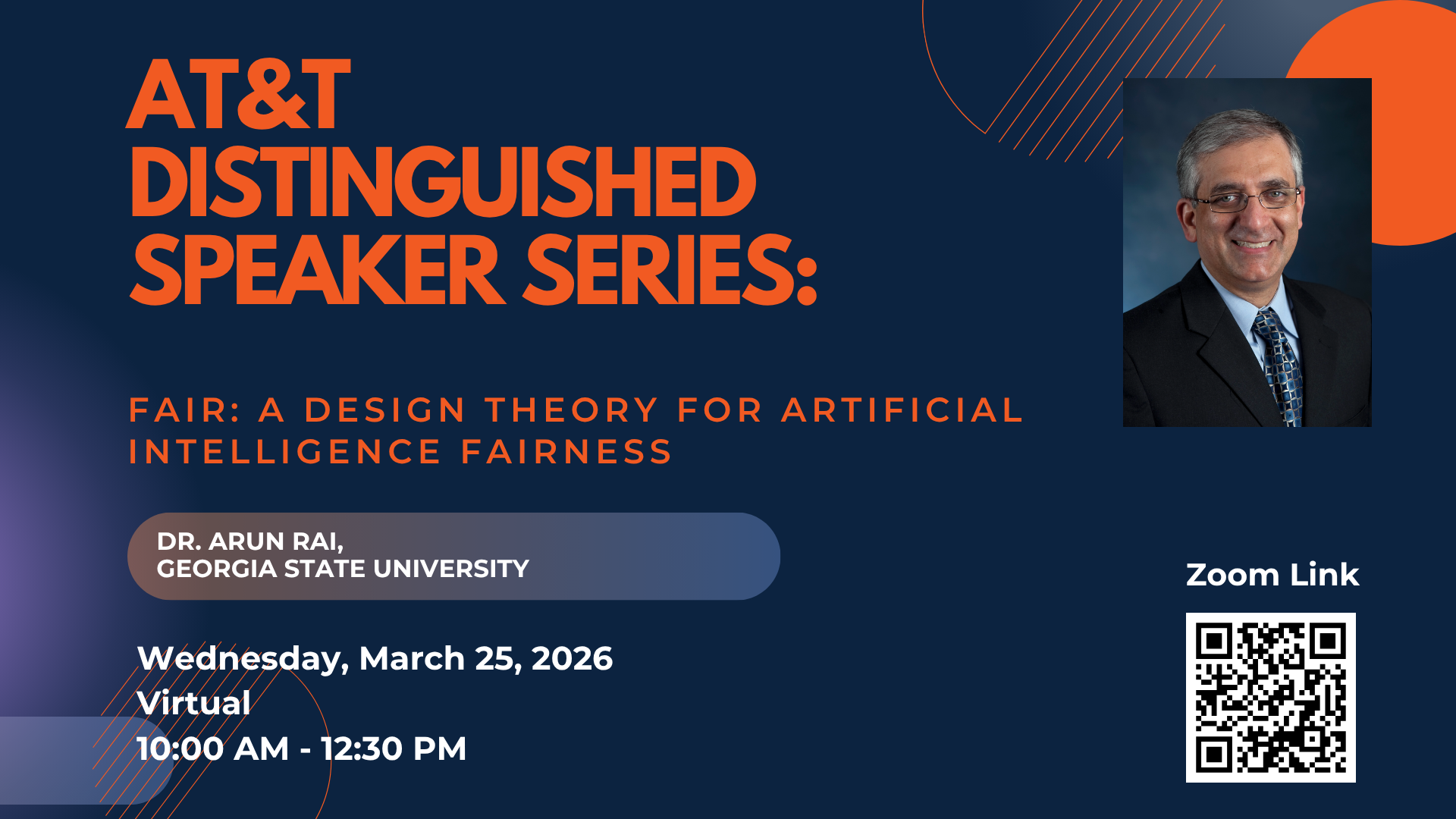
AT&T Distinguished Speaker - FAIR: A Design Theory for Artificial Intelligence Fairness
Location
Zoom
Online Location
Category:
Campus Events Students